

Why Industrial Hydraulic Services Matter for Uptime
Keeping Machines Moving When It Matters Most
Unplanned downtime is expensive, stressful, and often dangerous. For mining, construction, manufacturing and transport operators across Australia, a machine that stops unexpectedly does more than pause production; it can trigger missed contract deadlines, penalties, overtime costs and safety risks around stalled or unstable equipment.
Hydraulics sit at the centre of that risk. Excavators, haul trucks, drills, conveyors, cranes, compactors and processing lines all rely on stable hydraulic power to move, lift, clamp, push and control at the right speed. When a hose bursts, a valve sticks or a pump loses pressure, the whole operation can grind to a halt while crews scramble to respond.
This is why industrial hydraulic services are not just a repair function. They are a proactive way to protect uptime, keep teams safe and keep budgets predictable. At MHS Group Solutions, we focus on end-to-end support, from system design and fluid transfer to mobile hose repair and mechanical services, so hydraulic reliability becomes part of your operating strategy, not an afterthought.
In this article, we walk through how better hydraulic support reduces breakdowns, extends asset life and helps stabilise operating costs across heavy industry sites.
How Hydraulic Reliability Protects Your Bottom Line
The direct cost of a hydraulic failure is obvious: production stops, call-out fees start and emergency parts are ordered in a hurry. What hurts just as much are the flow-on delays when a stuck excavator blocks traffic, a failed cylinder halts a processing line or a downed crane holds up critical lifts.
Small issues are usually the starting point. A hose weep that goes unchecked, seals beginning to wear, a little fluid contamination or slow drips at fittings can all feel minor. Without timely attention from skilled industrial hydraulic services, these issues grow into blown hoses, scored cylinders, overheated pumps and damaged motors that take much longer to fix.
Hydraulic systems are built around consistent pressure and flow. If pressure is unstable, machines feel sluggish, operators slow down for safety and you lose output per hour. If pressure spikes, components are overloaded and you increase the risk of sudden failure. A well maintained system gives operators predictable control, which supports both productivity and safe working speeds.
Industrial hydraulic services that are planned and disciplined keep systems within design parameters. That means setting pressures correctly, managing temperatures, keeping contamination low and making sure relief valves and controls work as intended. When this is in place, you avoid overloading components, stretching hoses beyond their limits and bringing forward major capital costs on pumps, cylinders or entire machines.
Preventive Hydraulic Care That Keeps Assets Online
Effective preventive care is one of the best levers you have for uptime. A structured hydraulic service program should cover more than a quick once-over of the machine; it should include:
- Scheduled inspections of hoses, fittings, clamps and guards
- Cylinder and pump condition checks, including rod and housing inspection
- Valve and control function tests
- Fluid sampling, analysis and filtration checks
- Verification of pressures, flows and operating temperatures
When these tasks are documented and repeated to a set routine, patterns start to show. You might see pressure fluctuations at certain loads, rising oil temperatures on a specific shift or contamination trends tied to particular circuits. Condition monitoring like this lets you intervene early, instead of waiting for a failure to tell you something is wrong.
The choice of parts and fluids matters as well. Using OEM equivalent or better quality components, correctly rated hoses and fittings and the right hydraulic fluids for the application reduces wear, energy loss and heat build-up. This is especially important in demanding Australian environments where extremes in temperature, dust and moisture put extra stress on hydraulic systems.
Partnering with a specialist like MHS Group means service schedules can be tailored to the way your assets really work. Duty cycles, load profiles, site conditions and the criticality of each asset or circuit are all considered. High-criticality plant can get shorter inspection intervals and deeper checks, while less critical systems can be serviced on a longer cycle without increasing risk.
Fast Response Services That Cut Downtime Hours
Even with good preventive care, breakdowns still happen. The difference is how long they last. Fast, competent response keeps a bad day from turning into a lost shift or more.
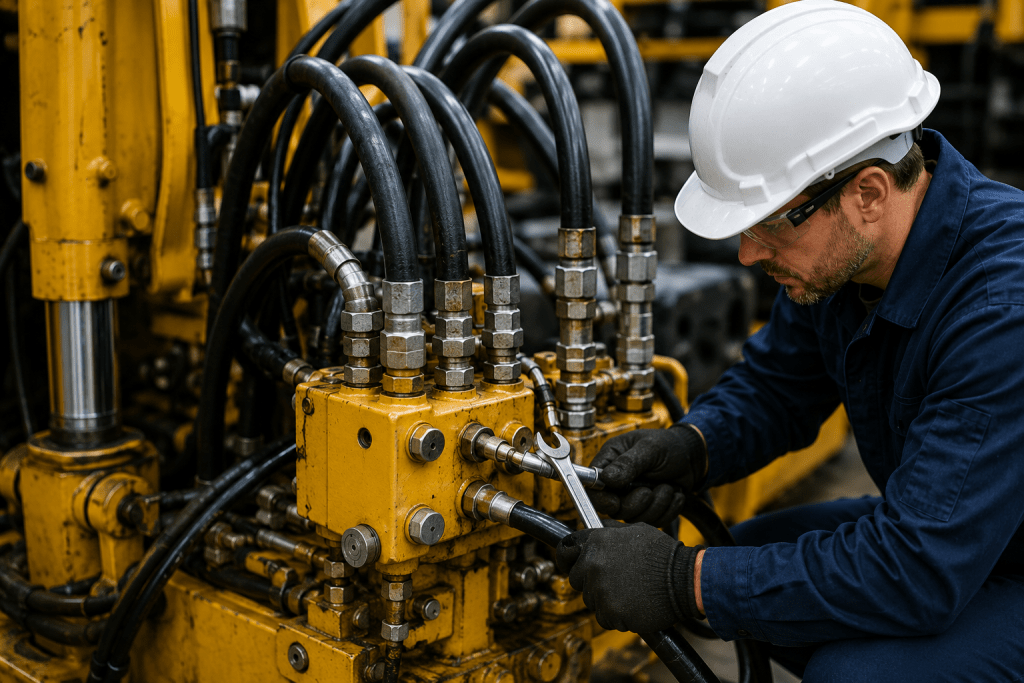
For many operators, especially in regional or remote areas, 24/7 emergency response, mobile service units and on-site hose repair are essential. Being able to bring industrial hydraulic services to the machine, instead of hauling equipment off site, can save hours. That time often decides whether a production target is still within reach.
Speed alone is not enough. Technicians who understand heavy industry applications can diagnose root causes, not just symptoms. This avoids repeat failures, unnecessary replacement of good parts and the frustration of calling someone back to fix the same fault twice. A structured approach to diagnostics, combined with experience across mining, construction and fixed plant, goes a long way.
Well-stocked service vehicles and strategic parts inventories make a big difference as well. Common hose types and sizes, fittings, seals, valves, filters and fluid are often needed on the spot. If they are already on the truck or available from a nearby hub, there is no waiting around while parts are sourced.
Clear communication between your maintenance team and the hydraulic service provider is just as important. When faults are reported clearly, access is arranged in advance and isolation or permits are planned, technicians can get straight to work. Coordinated planning around short stoppages or changeovers helps reduce disruption to the wider operation.
Custom Engineering for Demanding Fluid Power Tasks
Off-the-shelf hydraulic packages are designed for general conditions. Heavy industry rarely operates in general conditions. Mining, bulk materials handling, waste, ports and energy sites often have unique loads, duty cycles, contaminants and environmental demands that push standard systems to their limits.
Custom engineering fills this gap. Purpose-designed hydraulic power units, manifolds, fluid transfer skids and controls can be matched to specific machines or processes. Flow and pressure capacities, redundancy, cooling, filtration and control logic are all selected to fit the job, instead of forcing the job to fit the hardware.
There is also a lot of value in upgrading existing systems. Many operators run reliable machines with older valve banks, controls, hose routing, cooling and filtration. These can often be modernised to improve reliability, safety and maintainability without replacing the entire asset. Tidier hose layouts, better guarding, improved cooling circuits and smarter control packages all support uptime.
Thorough design, testing, commissioning and documentation by experienced hydraulic engineers helps standardise equipment across a site or fleet. Common component selections, consistent circuit layouts and clear documentation make future servicing faster and less error-prone.
Integrating Hydraulics with Broader Mechanical Services
Hydraulic systems do not exist on their own. They interact with structures, bearings, gearboxes, drives and rotating equipment. If one part of that chain is neglected, it can affect the rest.
Taking a whole-of-equipment view, where hydraulics and mechanical maintenance are planned together, has clear benefits. A leaking cylinder might be linked to misalignment in a structure. A pump issue might show up as vibration in a drive. When both scopes are considered, root causes are easier to spot.
Working with a single provider across hydraulic and mechanical scopes can reduce interface risk and duplicated labour. Site access, permits, supervision and planning are simpler when fewer parties are involved. It is also easier to coordinate shutdowns, overhauls and upgrades, because one team is looking at the machine as a complete system.
At MHS Group Solutions, our combined hydraulic, mechanical and fluid transfer capability is geared toward that integrated approach. We work with operators to standardise procedures, rationalise parts where practical and improve maintainability across sites so that uptime is protected from every angle.
Take Control of Uptime with Smarter Hydraulic Support
Industrial hydraulic services are not a reactive cost that sits in the background; they are a strategic lever for uptime, safety and predictable operating spend. When hydraulics are managed with the same discipline as production planning or safety systems, breakdowns become less frequent, less severe and easier to recover from.
It is worth stepping back and assessing your current hydraulic approach. How often are you dealing with unplanned failures? Are there repeat issues on certain machines or circuits? What do contamination levels in your oils look like over time? How long do you wait for critical parts, and how much time do technicians spend working around poor access or unclear documentation?
Answering questions like these is the first step towards a smarter hydraulic support model. From there, you can prioritise actions such as system health audits, critical hose reviews, updated service plans and targeted upgrades that deliver the most uptime for your effort.
Get Started With Your Project Today
If you are ready to improve reliability and reduce downtime on site, our team can tailor industrial hydraulic services to suit your operation. At MHS Group Solutions, we work closely with you to assess your current setup and recommend practical, cost-effective upgrades or maintenance strategies. Reach out to our specialists to discuss your requirements or request a quote via our contact page, and we will help you plan the next steps with clear timeframes and expectations.