

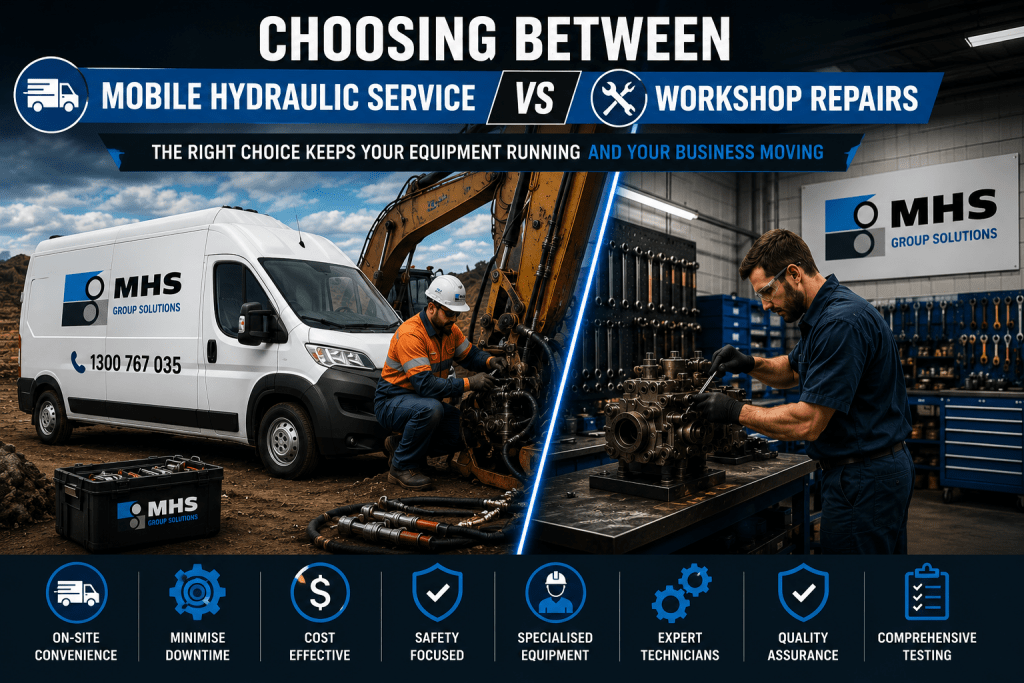
Choosing Between Mobile Hydraulic Service and Workshop Repairs
Keep Your Hydraulics Moving When it Matters Most
When a hydraulic hose bursts in the rain on a mine ramp or a tipper loses power on a highway, you do not have time to debate your options. You need to know straight away if you should call a mobile hydraulic service in Australia or plan to move the gear into a workshop. Making the wrong call can mean long delays, safety risks and unhappy clients.
Across mining, civil, agriculture and transport, winter work often ramps up while the weather turns cold, wet and windy. That is a tough mix for hoses, fittings and seals. In those moments, the choice between on-site help and workshop repairs can decide whether your day is a quick delay or a complete shutdown.
At MHS Group Solutions, we work across Australia with both 24/7 mobile units and fully equipped workshops. We see both sides every day, so we treat them as two tools in the same toolbox, not rivals. In this article, we will walk through how to weigh time, cost, safety, complexity and compliance so you can make the right call when pressure is on.
When Mobile Hydraulic Service Is Your Best Lifeline
When machines stop, everything stacks up behind them. On remote sites in WA, QLD or SA, waiting for a low loader or juggling schedules can lose a whole shift. Mobile hydraulic service in Australia is often the quickest way to get things moving again.
On-site response helps you reduce:
- Idle excavators, loaders, cranes or harvesters
- Missed loads, delayed pours and lost haulage slots
- Contract pressure when deadlines are already tight
During busy winter shutdowns or cropping prep, every hour counts. Breakdowns on highways, mine sites, ports or far-flung farms often cannot wait for workshop slots. A mobile technician can get to you, stabilise the fault and get you back into your run.
Safety is another big factor. Keeping the repair where the machine stands can:
- Avoid risky lifting, towing or loading of damaged gear
- Reduce traffic exposure on public roads
- Limit how far operators and fitters have to work in wet, low light conditions
When you work with a reputable provider, you also know technicians understand site inductions, permits and local safety rules. That helps protect everyone on the ground.
Typical mobile repair tasks include:
- Hose and fittings replacement
- Leak checks, fault finding and minor valve repairs
- Oil top-ups and basic leak rectification
- Mobile diagnostics and pressure testing
Mobile units are ideal for contained issues that are clear and fixable without a full stripdown. They get you back online fast and buy time to plan any deeper workshop work if hidden problems show up.
Why Some Jobs Belong in a Specialist Workshop
Not everything should be fixed in the mud or on the side of a road. Some hydraulic work simply needs the control and tools of a proper workshop.
Complex jobs that usually belong indoors include:
- Full cylinder rebuilds
- Pump and motor overhauls
- Manifold repair or remanufacturing
- Major system upgrades or re-plumbing
Workshops have precision tools, machining gear, test benches and clean work areas that you just cannot match on a job site. That level of control gives you better clearances, cleaner assemblies and more accurate testing. The result is long-term reliability instead of a quick patch that fails again at the worst time.
Quality control also steps up in a workshop. A good hydraulic workshop can:
- Run structured pressure and function tests
- Record results for warranty and compliance needs
- Carry out proper flushing and filtration on modern systems
That kind of work often extends component life and cuts down on repeat call-outs for the same fault.
You are likely ready for workshop support if you see:
- Recurring failures on the same circuit
- Heavy contamination in oil or components
- Unexplained overheating or noisy pumps
- Major leaks or suspected design issues
In many industries, a workshop is the right place for scheduled upgrades, such as fleet overhauls during shutdowns, marine hydraulic work or bigger plant changes. Workshops can also handle engineering changes, custom manifolds and system redesigns to make your hydraulics better suited to the work you actually do.
Cost, Downtime and Safety: Making the Smart Call
When you are standing next to a dead machine, the first thought is often about call-out cost. That number is only part of the picture. The bigger hit is usually downtime.
It often makes sense to:
- Use mobile service for a fast, contained fix that gets you working again
- Schedule a deeper workshop repair later during a planned outage
- Think about the cost of a stopped crew or line, not only the cost of a truck arriving
A simple rule of thumb helps. If the fault is local, visible and has not caused major damage, mobile is usually the first choice. If the failure is complex, mysterious or has spread through the system, workshop time can save money over the long run.
Risk and compliance also matter. Some equipment, such as registered road vehicles, cranes and lifting tools, must meet clear standards. Certain repairs need documented processes and test results that are easier to manage in a workshop setting. Environmental risk is part of this as well. Controlled handling, spill management and waste oil processes, both on-site and in workshops, help you avoid fines and clean-up problems.
Seasonal and operational planning can make all of this smoother. Cold, wet conditions tend to:
- Increase hose and fitting failures
- Make access to machines harder and slower
- Stretch on-site teams that are already busy
A good approach is to use quieter periods to handle workshop overhauls, upgrades and design changes, then rely on rapid mobile response for the unexpected issues that pop up in busy seasons. That mix keeps both your risk and your stress levels lower.
How MHS Group Solutions Supports Both Paths
MHS Group Solutions is set up to give you both speed and depth. Our 24/7 mobile units and our workshop teams work together so you do not have to choose one or the other forever. You get the option that suits the job.
In practice, that can look like this:
- A mobile technician attends a breakdown and makes the machine safe
- Quick repairs are done on-site where possible
- Components or whole units are then moved into a workshop if a deeper fix is needed
Because we operate across Australia, we focus on keeping our standards consistent between mobile and workshop work. That way, you know what to expect, whether the repair happens at your gate or on our floor.
We also bring in-house engineering support to recurring problem areas. That might mean:
- Redesigning a troublesome circuit
- Creating a custom manifold or better layout
- Matching system design to how your operators really use the gear
This blend of workshop-based redesign and on-site inspection works well across mining, civil, transport, agriculture, ports, manufacturing and other heavy industries. It lets you move from simply reacting to breakdowns to improving the system as a whole.
When a breakdown does happen, we help weigh up mobile versus workshop or a staged mix of both. Having basic details ready, such as symptoms, location, access limits and safety issues, means we can send the right response from the start and reduce back-and-forth.
Take Control of Your Hydraulic Uptime Today
Choosing between mobile hydraulic service in Australia and workshop repairs is not about which option is better overall. It is about which option fits the fault in front of you. Urgency, safety, fault complexity, cost of downtime and compliance needs all play a part in that decision.
By lining up a clear maintenance plan that blends regular workshop work with fast mobile support, you can face the rest of winter and the seasons ahead with more confidence. That way, when the next hose bursts or pump starts to complain, you already know your next move and who is going to back you up.
Get Started With Your Project Today
If your machinery is slowing you down or you want to prevent unexpected breakdowns, we are ready to help you on site. Explore our mobile hydraulic service in Australia to see how MHS Group Solutions can support your equipment across key regions. For tailored advice or to book a visit from our technicians, simply contact us and we will work with you to keep your hydraulics performing at their best.